

Macbeth and why Shakespeare still matters

William Shakespeare’s influence on the English language and literature is undeniable. Theoretically, at least, but practically Shakespeare’s writing is not enjoyed or appreciated by common readers nearly enough. His writing has been labelled problematic, outdated, confusing, and even boring. It would seem the main deterrents for readers are the linguistic intricacies. Nevertheless, despite all challenges, reading Shakespeare is a worthy task. Some of the playwright’s characters and lines are popularly used today – from Juliet’s “Romeo, Romeo! Wherefore art thou Romeo?” to Hamlet’s “to be, or not to be, that is the question.” These stories are timeless and central to the development of all the literature we read today. But “fair is foul, and foul is fair,” one shouldn’t live life without ever reading MacBeth. Let’s talk about the Scottish king.
Characters and storytelling
Macbeth is one of Shakespeare’s best-known tragedies. Taking place in 11th-century Scotland the setting and context of the play may seem outdated and unrelatable, almost exotic to a modern reader, especially on account of the witches and ghosts. Nonetheless, the characters, plot, and general story are as relevant as they would have when the play was written in the early 17th century – though one may need the assistance of a map to track the events in the Scottish Highlands, it is safe to assume the original audience may have faced a similar predicament.
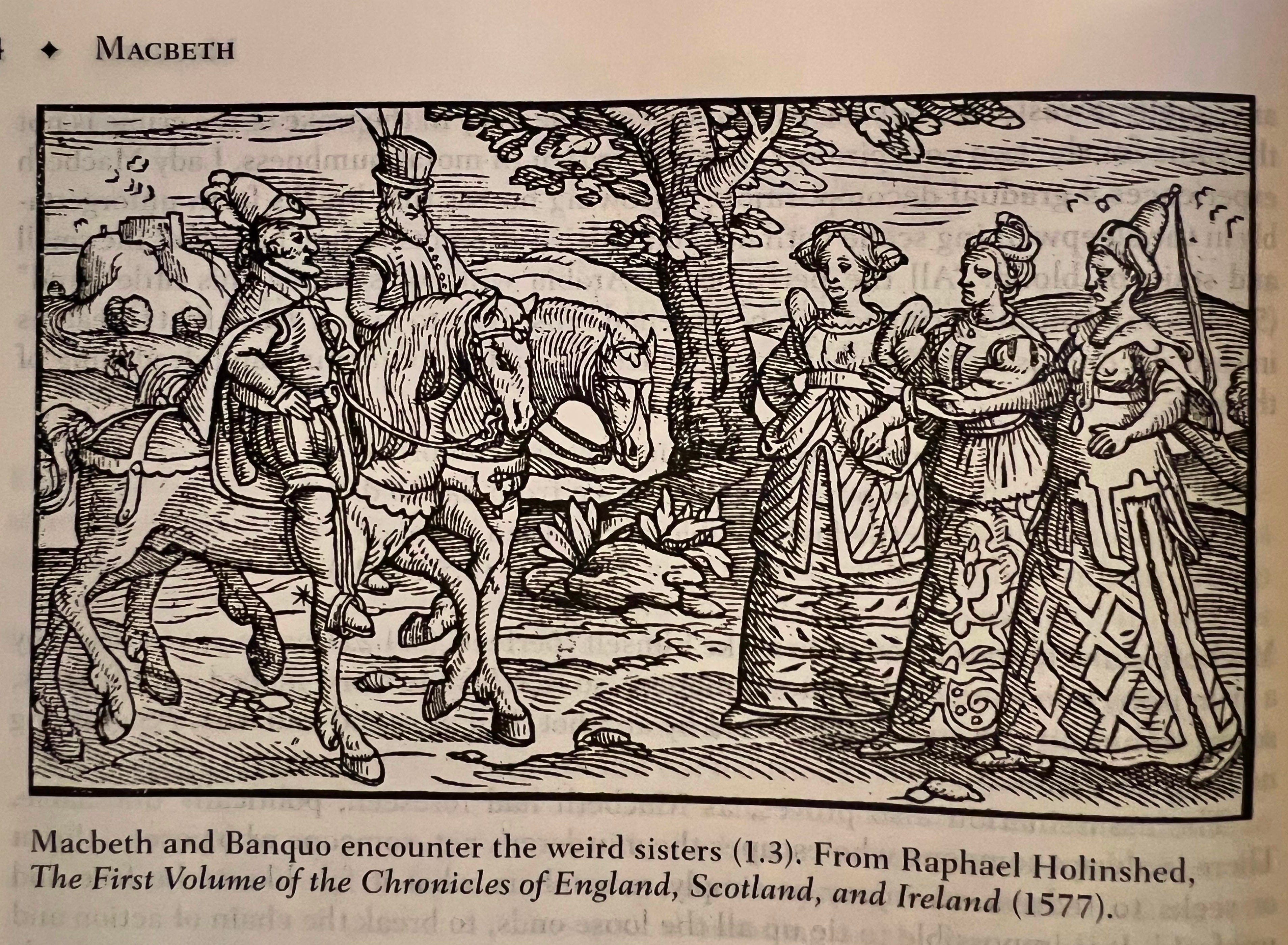
The story of Macbeth is tragic, and yet brilliant. The murky morality of its characters is one of the main elements that make this play enjoyable and relatable to modern life and day-to-day challenges – murdering aside, of course. As in every other Shakespearean tragedy, death plagues the play. Set ten centuries before our time, it is no surprise that the described world is violent and brutal. Early on, the main character, Macbeth, is described as a hero and close, trusted advisor to his king; although his heroic stance is quickly altered by his actions. Following an encounter with three witches that foretell his future of becoming King of Scotland, he finds himself forcing destiny’s hand: he kills, lies, and betrays. With the faithful guidance and support of his wife – Lady Macbeth – who might be one of the greatest theatrical characters ever written. In fact, she is often seen as the true brains behind the evil deeds that take place at their castle: from killing the king, to ordering assassinations to name some.
In Macbeth’s play Shakespeare introduces complex nuanced characters; the reader can almost feel the dreadful effects their actions have on their minds, as their guilt-ridden consciences lead them to slowly crumble, fall apart, and eventually die.
Nevertheless, Macbeth’s characterization is not necessarily that of a villain but an antihero, because although he has heroic qualities – such as bravery or loyalty – his greatest flaws are his weak morality, cowardice, and malleable character, which ultimately lead to his downfall. This concept of anti-hero has become popular in modern literature as society finds flawed characters more relatable and believable, so modern readers would easily find an appealing character in Macbeth. The motivations of anti-heroes are often topic of discussion as they can be understood in various, sometimes conflicting, ways – Macbeth is no different.
Some see him as a pawn of his wife, nudged by the witches’ prophecy, and therefore somewhat irresponsible of his actions; others see him as a power-hungry villain. Even though one could easily argue that a villain is fueled by evil actions and motives, unaffected by guilt or remorse, and Macbeth is eaten away by both. Furthermore, another argument is that Macbeth was turned away from his heroic path by the witches’ prophecy, leading him to believe that he is but an object in an already set future. Therefore, if understood that way, Macbeth if more befitting of an anti-hero than a villain.
These discussions of morality, consequences, and motive are part of what make Shakespeare’s plays worthy of studying and enjoyment today. Since, although the flaws of Macbeth and Lady Macbeth are relatable, their actions aren’t; one can see how they may have felt entrapped by a situation they didn’t know how to or if they could escape. Shakespeare artfully shows that the world does not exist as all good or all bad, there is nuance. People are complicated and at times they may make a poor decision that makes them feel trapped in problematic circumstances of their own making.
Language and Linguistics
Arguably, language and linguistics are the more challenging part of reading Shakespeare. Some of the words and grammar may be archaic and no longer used today, but that should not disqualify his plays and sonnets from being included in everyone’s reading lists. The fact is that the language of Shakespeare is largely not-of-our-world but that of 16th century England. What is more, his plays were always written to be performed so upon reading them one needs to bear this important detail in mind too, and remember that it is not the same to say “stars, hide your fires; / Let not light see my black and deep desires” than “stars, hide your light so no one can see the terrible desires within me.” The language of theater and poetry is similar to that of music, in them meaning and form are equally important. Although the language of Shakespeare might be challenging, it allows readers to gauge the complexity and beauty of the English language, thus earning the reader greater understanding of their linguistic choices.
Indeed, Shakespeare’s greatest gift to the world was language, the very thing criticized for its difficulty or archaism.
William Shakespeare is credited with the creation of more than 1,700 English words that are still in use today. It may seem impossible but some of the words credited to the playwright are so embedded in the language, one couldn’t do without them: alligator, bedroom, fashionable, gossip, puppy dog, undress, varied, gloomy, luggage, savagery, swagger, flawed, unreal, dishearten…
Unreal is that society uses Shakespearean English without knowing. Flawed is a world that undermines the benefits of reading challenging texts. Now it seems laughable to deem Shakespeare completely archaic, doesn’t it?
Put aside the impact on the English lexicon, Shakespeare’s identity of poet and playwright explains why his plays are full of sonnets, rhymes, and poetic devices. The difference in musicality from the original version to modern English hints at the uniqueness of Shakespearean English. Macbeth is filled with poetry and stylism, and it also contains some of the most rhythmical passages in Shakespeare’s plays. To demonstrate it, let’s compare the original version, a modern adaptation, and a Spanish translation of the three witches’ chant
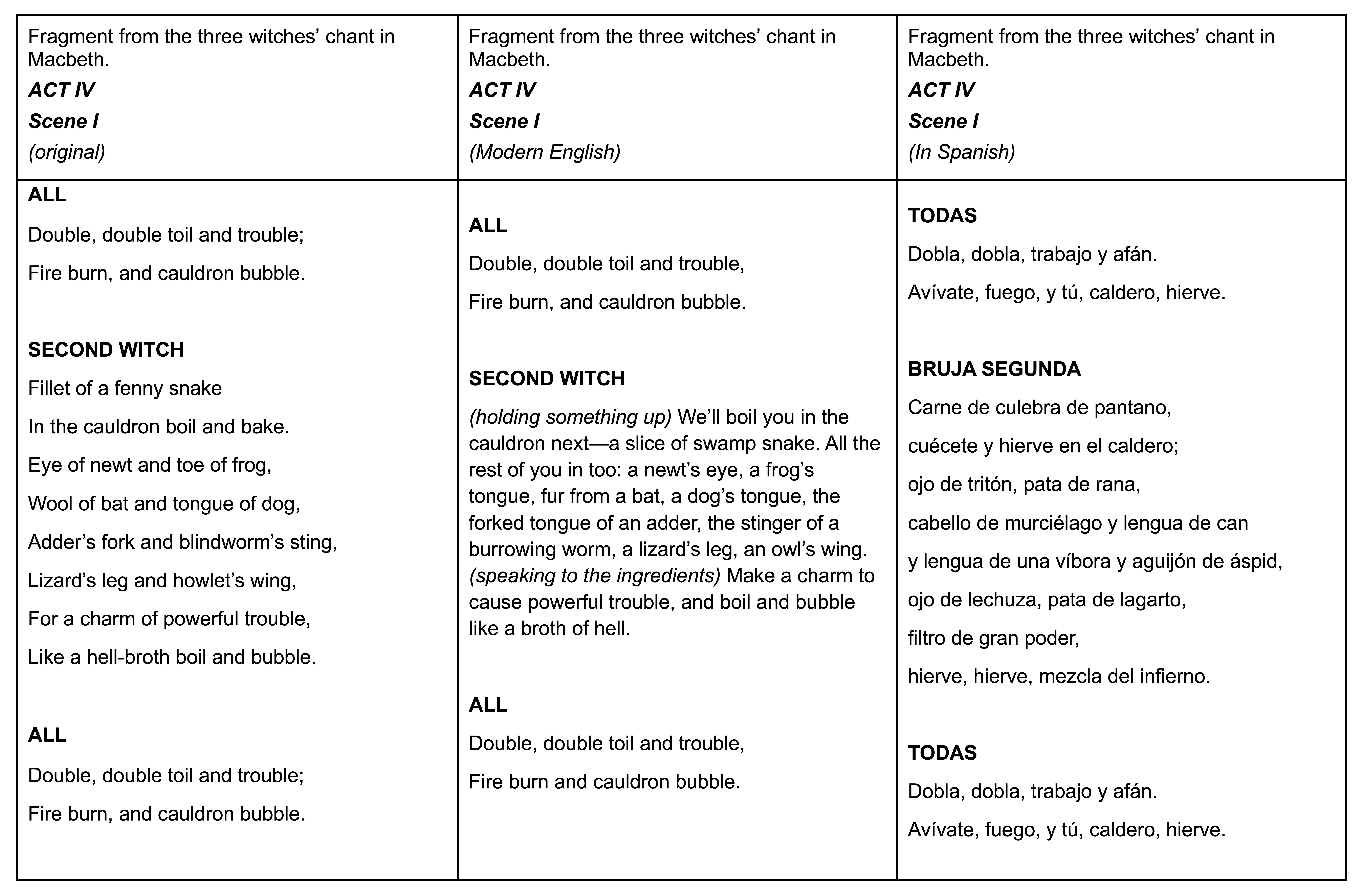
Reading these different versions of the witches’ chant one needs to remember that what they’re reading is a play, meant to be performed. Without analyzing the language too much, speaking the words out loud gives the reader unmistakable information: the original English rolls of the tongue, unlike in the other two. This cadence exists only in English, and more concretely only in the “problematic, outdated, confusing, and even boring” English of Shakespeare. The true magic that hides in his plays and sonnets is a privilege reserved to English speakers alone.
It is for the audience to determine whether they are willing to sacrifice form and style to meaning. Reading the Modern English adaptation of the passage, the meaning prevails, and a couple of the rhymes have been preserved. But broad understanding of meaning alone does not contribute to characterization or atmosphere in fiction. The modernized version of the chant isn’t much of a chant at all, it does not feel like an incantation and the character does not feel very witch-like either. The essence, the soul that comes from the musicality of poetry is lost.
A similar thing happens in the Spanish translation. The jest of the play remains, with facts and events unchanged. However, like in the modern English version, there are dimensions to meaning that are lost in translation. In Spanish there is no rhyme, and the rhythm is gone too – a similar occurrence in all other translations one would imagine. It is not the same, but how could it? Poetry is the one literary genre that does not translate well as each language’s characteristics are unique and specific by means of grammar, pronunciation, and vocabulary. As such, to find an equivalent to Shakespeare’s English in another language is virtually impossible. Therefore, the magic of the witches does not seep through in Spanish, and it never could despite a translator’s best efforts.
If we compare the original Middle English version and the Spanish version side by side, the linguistic differences are unbridgeable. In language A (original English) it reads Double, double toil and trouble; / Fire burn, and cauldron bubble which is made up of eight syllables and seven syllables per line respectively, with an internal rhyme in the first line and a rhyme pattern of AA rhyming trouble and bubble. These linguistic choices are impossible to carry through in language B (Spanish) whilst preserving the original meaning. In translation, it is a common phenomenon that one ought to choose between form and meaning – especially in poetry. If the translator and editor tried matching the linguistic features of the writing in languages A and B, they would have to take great liberties and go to great lengths to de facto rewrite the original writing. Then, both texts would differ so much from one another that they would resemble each other in plot only. And, reading that new monstruous creation, could one really say the translation and the original were examples of the same play? Most definitely not.
In the end, Shakespeare’s writing may be somewhat difficult to a modern reader, but in essence it is a gift for any and all English speakers. Arguably, Shakespeare contributed to the English language more than any other writer in history and his contributions to language and literature can only be appreciated in their original form. Therefore, it is crucial for modern society’s growth and development – linguistically, and culturally – to be able to overcome the initial discomfort of getting used to the language of Shakespeare. A reader that engages with Shakespeare and works to understand his plays in meaning and in form will be an undoubtedly better user of language. There is great power bestowed on they who can bend meaning to their will, so read and speak as Shakespeare would: artfully and responsibly.